
Welcome to Dr. Krishna Kumar M.S. – Robotic Joint Replacement Specialist
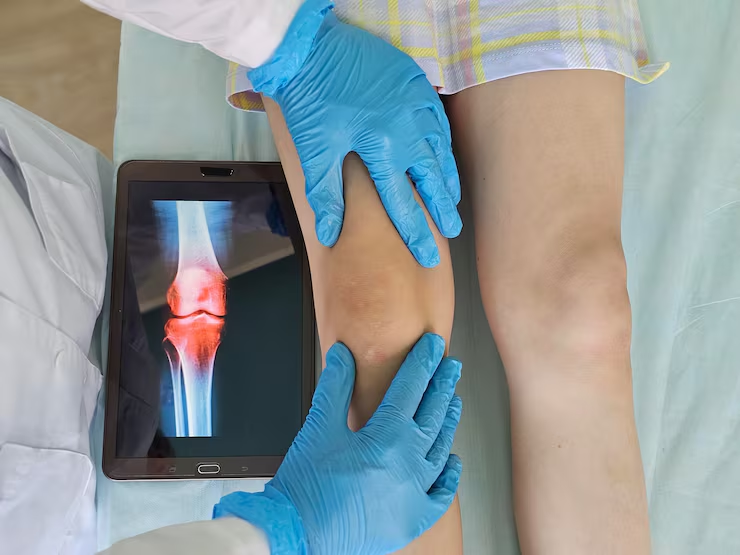
When a previously implanted joint replacement begins to fail — causing renewed pain, instability, or reduced function — revision joint replacement surgery may be necessary. This is a significantly more complex procedure than primary joint replacement, requiring specialized surgical expertise, advanced implants, and thorough pre-operative planning. Dr. Krishna Kumar M S performs revision joint replacement surgery in Whitefield, Bangalore for failed knee, hip, and shoulder replacements.
With a meticulous diagnostic workup, patient-specific surgical planning, and access to specialized revision implant systems, Dr. Krishna Kumar M S addresses even complex revision cases with precision and care.
Revision joint replacement surgery involves removing all or part of a previously implanted artificial joint and replacing it with new components. Unlike primary replacement, revision surgery must account for bone loss, scar tissue, altered anatomy, and the challenges of removing well-fixed implants. The procedure requires specialized revision implants — often longer stems, augments, and bone graft materials — to restore the joint and achieve stable fixation.
Every revision case is unique. Dr. Krishna Kumar M S conducts a comprehensive evaluation to identify the precise cause of implant failure before planning the surgical strategy.
Extensive Pre-Operative Workup: Joint aspiration for culture and sensitivity (to rule out infection), CT scan for bone stock assessment, bone density evaluation, and templating for revision implant sizing.
Implant Removal: Carefully removing well-fixed implants without causing excessive bone loss is one of the most challenging aspects of revision surgery, requiring specialized instruments and techniques.
Bone Grafting: Where significant bone loss is present, structural or morselized bone graft — or synthetic bone substitutes — may be used to restore adequate bone stock for implant fixation.
Specialized Revision Implants: Longer stems, augments, and modular revision systems are used to achieve stable fixation in compromised bone environments.
Revision joint replacement demands a higher level of surgical expertise, diagnostic acumen, and planning than primary replacement. Dr. Krishna Kumar M S brings all of these to every revision case:
Revision joint replacement surgery achieves an 85–90% success rate, with most patients experiencing significant improvement in pain and function compared to their failed implant state. While revision surgery carries a higher risk profile than primary replacement, outcomes in experienced hands are excellent. Long-term follow-up with regular X-rays is important to monitor implant stability and catch any issues early.
Signs that may indicate a need for revision surgery include new or worsening pain after a period of good function following your original joint replacement, instability or joint giving way, swelling, warmth or redness around the joint (which may indicate infection), or reduced range of motion. A consultation with Dr. Krishna Kumar M S including X-rays and possibly joint aspiration will determine whether revision surgery is needed and what type.
Yes, revision joint replacement carries a higher risk than primary replacement due to factors such as bone loss, altered anatomy, scar tissue, and the complexity of removing existing implants. Risks include higher infection rates, greater blood loss, nerve injury, and longer recovery. However, in experienced surgical hands with thorough pre-operative planning, the vast majority of revision procedures achieve excellent outcomes and significant patient benefit.
Revision implants are designed to provide durable, long-lasting function. With appropriate implant selection and surgical technique, revision replacements can last 10–15 years or more, though longevity is influenced by the patient's age, activity level, bone quality, and the cause of the original failure. Regular follow-up with imaging is recommended to monitor implant performance over time.
The most common causes of joint replacement failure include implant loosening (aseptic loosening), periprosthetic infection, polyethylene bearing wear, implant fracture, joint instability/dislocation, and stiffness. Less common causes include allergic reactions to implant materials and periprosthetic fractures (fractures around the implant). Understanding the specific cause of failure is essential for planning the correct revision strategy.
Recovery from revision joint replacement is generally longer than primary replacement, typically taking 12–18 months for full functional recovery. The initial post-operative period involves restricted weight-bearing and careful physiotherapy. Patients usually regain functional independence within 3–6 months, with ongoing improvements in strength and mobility continuing through the first year and beyond.
Don't suffer in silence. Get a thorough expert evaluation of your joint replacement from Dr. Krishna Kumar M S and find out if revision surgery can restore your quality of life.
Book Your Consultation