
Welcome to Dr. Krishna Kumar M.S. – Robotic Joint Replacement Specialist
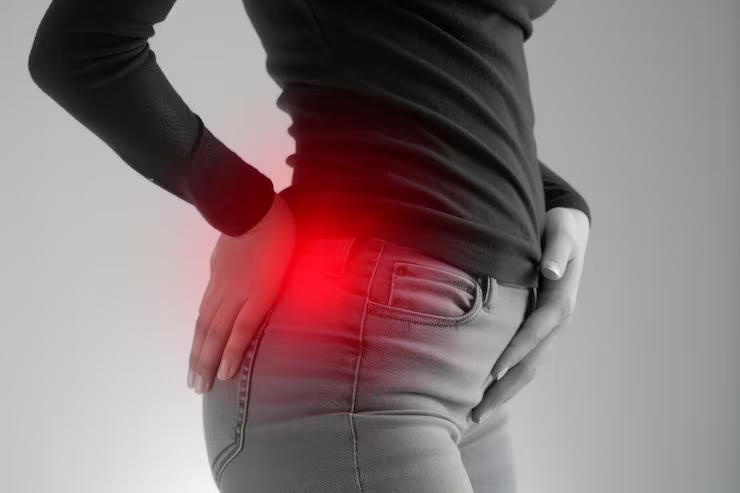
Hip Pain Treatment

Hip Pain Treatment in Whitefield Bangalore by Dr. Krishna Kumar M S

Hip Pain Treatment in Whitefield, Bangalore

Hip pain is one of the most debilitating orthopedic complaints, affecting your ability to walk, climb stairs, sit comfortably, and even sleep through the night. The hip joint is a ball-and-socket joint — the largest weight-bearing joint in the human body — and when it is compromised, it disrupts virtually every aspect of daily life. Dr. Krishna Kumar M S provides comprehensive hip pain treatment in Whitefield, Bangalore, using evidence-based protocols that range from conservative physiotherapy and injection therapies to advanced hip arthroscopy and hip replacement surgery for end-stage disease.

Whether your hip pain stems from arthritis, a labral tear, bursitis, or impingement, an accurate diagnosis is the cornerstone of effective treatment. Dr. Krishna Kumar M S brings a systematic, patient-first approach to every hip pain consultation, ensuring that the root cause is identified before any treatment is prescribed.

Understanding Hip Pain

The hip joint is formed by the head of the femur (thigh bone) fitting into the acetabulum (the socket of the pelvis), held together by a strong fibrocartilaginous ring called the labrum, powerful muscles, tendons, and ligaments. This complex structure allows a wide range of motion — flexion, extension, abduction, adduction, and rotation — while simultaneously supporting the full weight of the upper body.

Location of pain is a key diagnostic clue:

Hip Pain by Location

  • Groin pain: Typically indicates intra-articular pathology — hip arthritis, labral tears, or femoroacetabular impingement (FAI) are common causes
  • Lateral (outer) hip pain: Usually points to trochanteric bursitis, iliotibial band tightness, or gluteal tendinopathy
  • Buttock pain: May suggest piriformis syndrome, sacroiliac joint dysfunction, or referred pain from the lumbar spine
  • Acute hip pain: Sudden onset, often following trauma, fracture, or acute labral injury
  • Chronic hip pain: Gradual onset, usually degenerative in nature — arthritis, avascular necrosis, or long-standing bursitis

Common Causes of Hip Pain We Treat

Dr. Krishna Kumar M S diagnoses and treats the full spectrum of hip pain conditions, including:

  • Hip Osteoarthritis: Progressive cartilage wear within the hip joint leading to bone-on-bone friction, groin pain, stiffness, and reduced mobility — the most common cause of hip pain in adults over 50
  • Hip Labral Tears: Damage to the fibrocartilaginous labrum that lines the acetabulum, causing sharp groin pain, clicking sensations, and a feeling of joint locking — often seen in younger active individuals
  • Femoroacetabular Impingement (FAI): Abnormal bony contact between the femoral head and acetabulum during hip movement, causing pain in flexion and internal rotation — a common cause of labral tears and early arthritis
  • Trochanteric Bursitis: Inflammation of the bursa overlying the greater trochanter on the outer hip, causing lateral hip and thigh pain, especially when lying on the affected side or climbing stairs
  • Avascular Necrosis (AVN) of the Hip: Loss of blood supply to the femoral head causing bone death and eventual collapse — associated with steroid use, alcohol, and trauma; requires early intervention to preserve the joint
  • Snapping Hip Syndrome: An audible or palpable snapping around the hip caused by tendons flicking over bony prominences — may be painless or associated with discomfort in active individuals
  • Piriformis Syndrome: Irritation of the piriformis muscle in the buttock causing deep buttock pain and sciatica-like symptoms as the sciatic nerve passes nearby
  • Hip Fractures: Particularly in elderly patients with osteoporosis following a fall — a medical emergency requiring urgent orthopedic management

Diagnosis of Hip Pain

Accurate diagnosis distinguishes hip joint pathology from referred pain originating in the lumbar spine, sacroiliac joint, or surrounding soft tissues. Dr. Krishna Kumar M S uses a structured diagnostic protocol:

  • Detailed History & Pain Mapping: Precise identification of pain location (groin vs. lateral vs. buttock), onset, aggravating factors, and associated symptoms guides the diagnostic pathway
  • Gait Analysis: Observation of walking pattern reveals antalgic gait, Trendelenburg sign (gluteal weakness), or limping that indicates specific muscle or joint involvement
  • Clinical Examination: Range of motion testing, FABER/FADIR impingement tests, Thomas test, and palpation over bursae and tendon insertions help localize the problem
  • X-Ray: First-line imaging to assess joint space narrowing, osteophyte formation, femoral head shape abnormalities (cam/pincer deformity in FAI), and signs of AVN
  • MRI of the Hip: Gold-standard imaging for soft tissue evaluation — labral tears, cartilage damage, tendon injuries, early AVN, and bone marrow edema are clearly visualized on MRI
  • Diagnostic Intra-articular Injection: When the source of pain is unclear, a guided injection of local anaesthetic into the hip joint helps confirm intra-articular origin — a positive response confirms the hip is the pain generator

Non-Surgical Hip Pain Treatments

Dr. Krishna Kumar M S adopts a conservative-first philosophy, reserving surgery for cases where non-surgical measures have failed to provide adequate relief. Non-surgical options include:

  • Physiotherapy & Hip Strengthening: Targeted exercises to strengthen the hip abductors, flexors, and core musculature reduce joint loading and improve stability — a cornerstone of non-surgical hip pain management
  • Activity Modification: Guidance on avoiding aggravating positions and movements (deep hip flexion, prolonged standing) while maintaining safe activity levels for overall joint health
  • NSAIDs (Anti-inflammatory Medications): Oral non-steroidal anti-inflammatory drugs reduce pain and swelling during acute flares of bursitis, arthritis, and impingement
  • Corticosteroid Injections: Ultrasound or fluoroscopy-guided cortisone injections into the hip joint or trochanteric bursa provide targeted, rapid relief — particularly effective for bursitis and early arthritis
  • PRP (Platelet-Rich Plasma) Therapy: Concentrated growth factors from the patient's own blood are injected into the hip joint to promote cartilage healing, reduce inflammation, and delay the progression of early arthritis
  • Weight Management Counselling: Every kilogram of body weight reduction translates to a 3–4 kg reduction in hip joint loading — even modest weight loss significantly reduces hip pain and slows arthritis progression

Surgical Options for Hip Pain

When non-surgical treatments are insufficient, Dr. Krishna Kumar M S offers minimally invasive and definitive surgical solutions tailored to the underlying diagnosis:

  • Hip Arthroscopy for Labral Repair: A keyhole procedure using a small camera and specialized instruments to repair or reconstruct a torn labrum, remove loose bodies, and smooth damaged cartilage — ideal for younger, active patients with labral tears and FAI
  • FAI Correction (Femoroplasty/Acetabuloplasty): During hip arthroscopy, the abnormal bony prominences causing impingement are reshaped to restore normal hip joint mechanics and prevent further labral damage
  • Core Decompression for Avascular Necrosis: In early-stage AVN, drilling channels into the femoral head reduces intra-osseous pressure and stimulates revascularization, potentially halting progression and preserving the native hip joint
  • Total Hip Replacement (THR): For end-stage hip arthritis or advanced AVN, total hip arthroplasty replaces the damaged femoral head and acetabular socket with durable implants, providing lasting pain relief and restored function — Dr. Krishna Kumar M S performs both conventional and robotic-assisted hip replacement

Why Choose Dr. Krishna Kumar M S for Hip Pain Treatment

  • Accurate Hip Pain Diagnosis: A rigorous, structured diagnostic approach using clinical examination, imaging, and diagnostic injections ensures the true source of your hip pain is correctly identified before any treatment begins
  • Conservative Management First: Every patient receives a thorough trial of physiotherapy, lifestyle modification, and injection therapies before surgical options are considered — protecting your joint for as long as possible
  • Advanced Hip Arthroscopy: Expertise in keyhole hip surgery for labral repair, FAI correction, and cartilage procedures allows younger patients to avoid or delay hip replacement through joint-preserving interventions
  • Hip Replacement Expertise: For patients who require definitive surgery, Dr. Krishna Kumar M S performs total hip replacement using advanced implant systems and robotic guidance for optimal positioning and long-term implant survival
  • Post-Treatment Rehab Support: Structured physiotherapy protocols after every procedure — whether injection, arthroscopy, or hip replacement — ensure the best possible functional recovery and return to an active lifestyle

Frequently Asked Questions — Hip Pain Treatment

Hip pain when walking can arise from several causes depending on where the pain is felt. Groin pain during walking is most commonly caused by hip osteoarthritis or femoroacetabular impingement. Lateral hip pain that worsens when walking is typically due to trochanteric bursitis or gluteal tendinopathy. Buttock pain while walking may indicate piriformis syndrome or referred lumbar spine pain. In elderly patients, a sudden onset of severe hip pain during walking after a minor fall must be evaluated urgently for a hip fracture. An accurate diagnosis by Dr. Krishna Kumar M S is essential to direct the right treatment.

Hip replacement is considered when hip pain is severe enough to significantly limit daily activities — walking, dressing, or sleeping — and has not responded adequately to at least 3–6 months of conservative treatment including physiotherapy, medications, and injections. X-ray findings showing near-complete loss of joint space, bone-on-bone contact, and deformity alongside disabling pain are clear indicators. The decision is always individualized. Dr. Krishna Kumar M S evaluates each patient's pain severity, functional limitations, imaging findings, age, and overall health before recommending hip replacement.

Yes — the majority of hip pain conditions can be effectively managed without surgery. Conditions such as trochanteric bursitis, early hip arthritis, piriformis syndrome, and mild labral irritation often respond well to physiotherapy, anti-inflammatory medications, corticosteroid injections, and PRP therapy. Even in patients with moderate hip arthritis, a dedicated conservative management programme can provide years of symptom relief and delay or avoid surgery entirely. Surgery is reserved for cases where conservative treatment has genuinely failed and pain continues to impair quality of life.

The duration of hip pain treatment varies widely depending on the diagnosis and chosen approach. Trochanteric bursitis often improves within 4–8 weeks of physiotherapy and a single corticosteroid injection. Mild to moderate hip arthritis managed conservatively may take 6–12 weeks to show meaningful improvement. Hip arthroscopy for labral repair typically requires 3–6 months of rehabilitation for full functional recovery. Total hip replacement patients usually achieve pain relief within weeks, with full recovery and return to normal activities expected within 3–6 months. Dr. Krishna Kumar M S will provide a realistic and specific recovery timeline during your consultation.

Regain Pain-Free Hip Movement

Do not let hip pain limit your life. Consult Dr. Krishna Kumar M S in Whitefield, Bangalore for a precise diagnosis and a personalized treatment plan — from conservative care to advanced hip surgery.

Book Your Consultation