
Welcome to Dr. Krishna Kumar M.S. – Robotic Joint Replacement Specialist
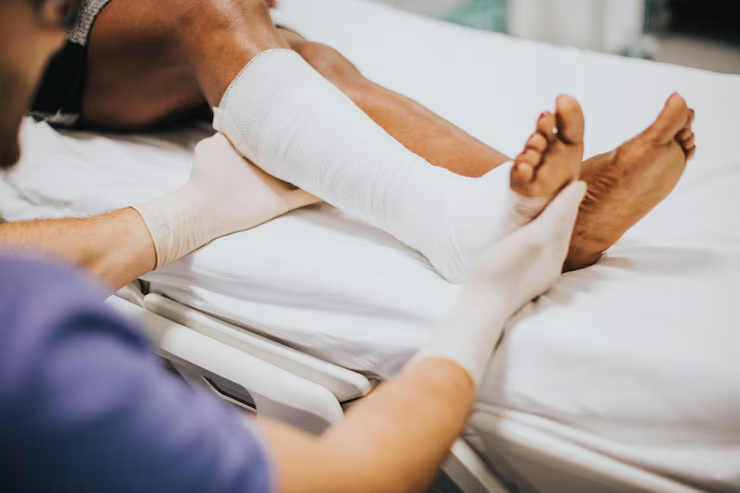
A fracture — a break in the continuity of a bone — is one of the most common orthopedic emergencies, occurring across all age groups from young athletes and road accident victims to elderly patients with osteoporotic bones. Prompt, expert management of fractures is critical: delayed or inadequate treatment leads to malunion (healing in a wrong position), non-union (failure to heal), joint stiffness, and long-term disability. Dr. Krishna Kumar M S provides comprehensive fracture and trauma care in Whitefield, Bangalore, managing the full spectrum of orthopedic injuries from simple closed fractures requiring casting to complex periarticular fractures and elderly hip fractures requiring urgent surgical fixation.
Fracture care is not merely about "setting the bone" — it is a comprehensive process that includes accurate classification of the fracture, selection of the optimal treatment method (surgical or non-surgical), precise execution of fixation or immobilization, and a structured rehabilitation programme to restore full function. Dr. Krishna Kumar M S guides patients through every step of this process with clear communication and expert surgical care.
Not all fractures require surgery. Stable, minimally displaced fractures in appropriate anatomical locations heal excellently with non-surgical management:
Unstable, displaced, open, or articular fractures require surgical fixation to restore bone anatomy, achieve stable fixation, and enable early rehabilitation:
Fracture healing time varies considerably depending on the bone involved, the type of fracture, the patient's age, and the chosen treatment. As a general guide: small bones like fingers and toes heal in 3–4 weeks; forearm and ankle fractures typically take 6–8 weeks; long bone fractures (femur, tibia) may require 3–6 months for full consolidation. Elderly patients and those with nutritional deficiencies or medical conditions (diabetes, osteoporosis) heal more slowly. Surgical fixation generally allows earlier function as the stable fixation protects the healing bone while physiotherapy proceeds. Bone healing is monitored with serial X-rays at follow-up appointments.
No — many fractures heal very well without surgery. Stable, minimally displaced fractures in appropriate locations (many forearm fractures, undisplaced ankle fractures, clavicle fractures, stable vertebral compression fractures) are successfully treated with casting, splinting, or functional bracing. Surgery is indicated when the fracture is unstable and would displace in a cast, when the fracture involves a joint surface and requires anatomical reconstruction, when the fracture is open and requires wound management, when non-surgical treatment would require prolonged immobility in an elderly patient (e.g., hip fractures), or when conservative treatment has failed and non-union has developed. Dr. Krishna Kumar M S makes individualized recommendations after careful assessment.
ORIF stands for Open Reduction and Internal Fixation — a surgical technique in which the fracture site is surgically opened to allow direct visualization, the bone fragments are reduced (repositioned) into their correct anatomical alignment, and then held in that position with internal metal implants (plates, screws, wires, or rods) that are implanted inside the body. "Open reduction" means the alignment is achieved through direct surgery (as opposed to closed reduction where the fracture is reduced without opening the skin). "Internal fixation" means the implants are placed inside the body permanently or semi-permanently. ORIF provides stable, anatomical fixation that permits early rehabilitation and is the standard treatment for many displaced and periarticular fractures.
Hip fractures in elderly patients are a medical emergency associated with significant mortality if not treated promptly. The treatment depends on the fracture type. Intertrochanteric fractures (below the femoral neck) are treated with surgical fixation using a dynamic hip screw (DHS) or intramedullary nail, preserving the patient's own femoral head. Displaced subcapital fractures (within the femoral neck), where the blood supply to the femoral head is compromised, are typically treated with hemi-arthroplasty — replacing the femoral head with a prosthesis — or total hip replacement in more active patients. The goal is to operate within 24–48 hours, allow immediate full weight-bearing the next day, and minimize the devastating complications of bed rest such as deep vein thrombosis, pulmonary embolism, pneumonia, and pressure ulcers in this vulnerable patient group.
Timely fracture management makes the difference between a full recovery and long-term disability. Contact Dr. Krishna Kumar M S in Whitefield, Bangalore for immediate assessment and expert fracture care.
Book Your Consultation